But…why?
(it's not as weird as it sounds)
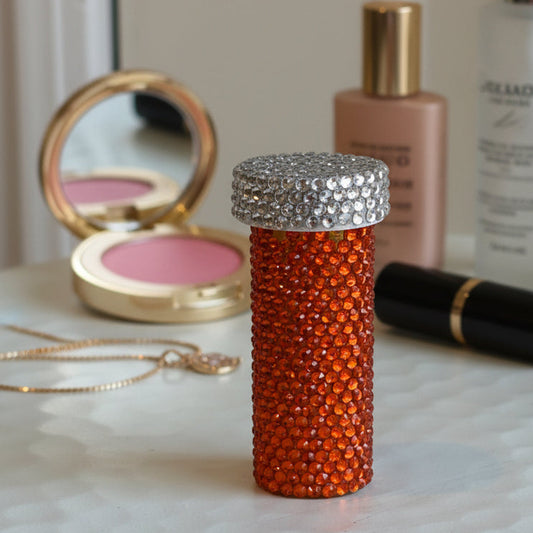
Yes, it's a bedazzled pill bottle.
Or a bedazzled tampon. Or a bedazzled compact mirror, or an Inkjoy Pen, depending which kit found its way to your kitchen table.
I know.
And yes, your first reaction might be "but why?" That's okay. That's most people's first reaction.
The second reaction, once they understand what actually happens in that room, is usually "okay but where do I get one."
So let's talk about why.
You are not imagining it.
You have friends. You have a group chat. You have people you love who would absolutely show up if something went wrong.
And you are still lonely.
Not the dramatic, nobody-loves-me kind of lonely. The quieter kind. The kind where you leave a girls night and realize you talked about schedules and TV shows and whose kid is doing what... and nothing else. The kind where you're around people you genuinely love and still somehow feel like no one really sees you.
That feeling has a name. It has a biology. It has a reason.
And there's nothing wrong with you.
You just got stuck in the small talk loop. And almost everyone you know is stuck there with you.
Small Talk isn't the problem. Staying there is.
Here's the thing about small talk: it's not bad. It's actually how every single relationship in your life started.
You talked about the weather. You asked about her job. You found out you both hate cilantro. You bonded over something small and safe and that was enough to open the door.
Small talk is the door. It was never supposed to be the whole house.
But somewhere between being a kid who made best friends in ten minutes on a playground and being an adult with a calendar full of obligations and exactly two hours a month to actually see your people... you got stuck at the door.
And here's where it gets painful: you can be lonely with people you love. If you've been circling the same safe topics with the same people for years, you can leave every hangout feeling vaguely empty and not know why. You're not ungrateful. You love these women. You're just not getting to the good stuff.
There are a few reasons this happens and none of them are your fault:
Life got busy. When you only have two hours a month with your friends, nobody wants to spend it being vulnerable. What if it gets weird? What if there isn't enough time to resolve it? So you keep it light. And light becomes a habit.
COVID broke something. A lot of people came out of the pandemic genuinely having forgotten how to go deep. The muscles atrophied. It feels scarier now than it used to.
The Midwest is its own thing. This probably applies to other areas of the country as well, but I've noticed that if you didn't grow up around here, if you're not part of a church community or still hanging out with your high school friends, plugging in can feel nearly impossible. People are lovely but the inner circles are already formed. It's easy to feel like an outsider even when everyone around you is perfectly nice.
We put ourselves out there every day. To our kids, our jobs, our partners, social media, a world that may or may not be accepting of what we have to offer. By the time we get to our friends, we're tired. Vulnerability takes energy and some days there's just none left.
So we stay surface level. Not because we don't care. Because it's safe. Nobody thinks you're weird for talking about the weather. Nobody thinks you're weak for saying you're fine.
But staying surface level won't get you where you want to go. You'll just end up lonelier than before.
And that feeling - being around people you love and still feeling unseen - is one of the most quietly painful experiences there is.
You didn't end up here because something is wrong with you.
You ended up here because nobody gave you a better on-ramp.
That's what I'm building.
When hands are busy, minds are open.
So why a craft kit? Why bedazzle a pill bottle, or a tampon, or a compact mirror?
Fair question. Stick with me.
There's something that happens when you give people something to do with their hands.
The eyes go to the project. The shoulders drop. The performative part of social interaction (the maintaining eye contact, the reading facial expressions, the trying to figure out what the other person is thinking), it all quiets down.
And when that quiets down, something else opens up.
You're not performing anymore. You're just talking. And listening. And when you respond, it comes from somewhere more honest than it would have across a dinner table where everyone is watching everyone else.
This is especially true for our neurodivergent ladies. Eye contact is exhausting. Knowing what to do with your body in a social situation is exhausting. Give someone a task - a real, tactile, satisfying task - and suddenly the social part gets easier. Not forced. Just easier.
And bedazzling specifically? It's the right kind of task, no matter which object you're covered in gems.
It's not so complicated that it demands your full attention. It's not so simple that your brain goes somewhere else entirely. It's that perfect middle zone: repetitive enough to be soothing, engaging enough to keep your hands busy, where the best conversations happen.
Pick up a gem. Place a gem. Pick up a gem. Place a gem.
"Repetitive motions are very good for our nervous system, emotional regulation, and stress relief." — Allie Joy, art therapist and licensed professional counselor, TIME Magazine, May 2026.
Turns out there's actual science behind why this feels good. The rhythm calms your nervous system. Lowers cortisol. Regulates your emotions. You're not just making something sparkly, you're physiologically preparing yourself to be more open.
I didn't know all of this when I started. I just knew something happened in the room when people started bedazzling. Strangers became friends. The shy person in the corner started talking. Someone said something honest and three other women leaned in instead of pulling back.
I've seen it happen at the local events I've hosted in Kansas City. And I've heard from women who've opened these kits at kitchen tables, on back porches, in living rooms across the country... and watched the same thing happen.
That's not an accident.
It just looks like magic. It's actually very, very intentional.
This is your brain on loneliness.
Here's something nobody tells you about loneliness:
It's not just emotional. It's biological.
Your brain runs on a set of chemicals (neuroscientist Loretta Breuning calls them your "happy chemicals"), and they were designed for a specific kind of social interaction. The kind that happens in person. In the same room. With real humans whose faces you can see and voices you can hear and physical presence you can actually feel.
These chemicals have names you might recognize:
Oxytocin. The bonding chemical. The one that makes you feel safe with another person. It releases through physical proximity, through being truly seen, through the experience of someone showing up for you in real time. It does not fire the same way through a screen. A text that says "I'm here for you" is lovely. It is not the same as being in the same room when someone says it to your face.
Serotonin. The one that makes you feel valued by your social group. It releases when someone in your community recognizes you, validates you, takes what you said seriously. When three women at a table lean in after you say something honest (instead of pulling back), that's serotonin. Your nervous system registers: I am safe here. I belong here.
Dopamine. The one that fires when you make progress toward something. Finishing your bedazzled kit (watching a plain pill bottle, a plain tampon, or a plain mirror turn into something ridiculous and beautiful), that's a pure dopamine hit. Small and real and satisfying. Your brain rewards completion. We built completion into the evening on purpose.
Endorphins. Released through laughter. And there is always laughter. The absurdity of what you're doing (sitting at a bar or your best friend's dinner table, covered in rhinestones, gluing gems onto a prescription bottle, a tampon, or a mirror) is genuinely funny. That laughter isn't a side effect. It's part of the mechanism.
Here's the part that should make you a little angry:
We have built an entire world of connection that bypasses almost all of these chemicals. Scrolling doesn't release oxytocin. Likes don't release serotonin the way a real human acknowledgment does. We have gotten very good at the simulation of connection and slowly, quietly, settled for it.
We've settled.
And we didn't even notice it happening.
Your loneliness isn't a personal failing. It's a rational response to a world that replaced something biological with something digital and called it progress.
You weren't designed for this. None of us were.
Self Disclosure (Or: Why you're still talking to that stranger from the bar)
There's a concept in psychology called self-disclosure. It sounds clinical. It isn't.
It's just this: when you reveal something real about yourself to another person, something shifts between you.
Here's how it works in real life.
You're sitting next to a stranger at a bar. You already have enough in common to start talking: you're at the same place, doing the same thing, probably drinking something similar. So you talk about the bar. The drinks. Whether you know the bartender. Easy. Safe. Fine.
And most of the time, it stays right there.
But then one of you mentions something real. Maybe you say you have a dog. Turns out she has a dog too. You compare breeds, complain about vet bills, pull up photos. And now something has changed. You're not just two strangers at a bar. You're two people with something in common that actually matters to you.
She says "we should meet up at the dog park sometime."
And just like that, you've moved.
That's self-disclosure. That's how it works. Every relationship in your life - romantic, platonic, professional, whatever - followed this exact pattern. It started with something small and safe, and it moved forward every time one of you revealed something a little more real than before.
Psychologists call these moments microcommitments. Little bets you place on each other. I'll tell you something true about me, you show me you can handle it, I'll tell you something truer. Back and forth, over time, that's how trust actually builds. That's how you get to the friendships that feel like home.
The problem is this takes time. And intention. And a level of vulnerability that feels genuinely scary... especially now, especially for women, especially when the world already asks so much of you every single day.
Most of us don't have a structure for it. So we stay at the bar, talking about the drinks, never quite getting to the dog park.
That's what the conversation card does in every kit, with whatever's sitting in front of you covered in rhinestones.
It's not a therapy prompt. It's not a forced sharing circle. It's just a structure: three questions, designed to move you past the weather and the schedules and the "I'm fine" into something that actually matters. The questions do the vulnerable part for you. They give everyone at the table permission to go somewhere real without anyone having to be brave enough to go there first.
You can pass. You can take it somewhere lighter if the room needs that. Nobody is required to go anywhere they don't want to go.
But almost everyone goes.
And when someone answers honestly - when she says the thing she's been carrying around - something happens.
Nobody thinks she's weird.
Nobody pulls back.
The women at the table lean in. They validate her. They show her they care. Some of them say "me too." Some of them don't understand but show up anyway.
Her nervous system registers: I am safe here.
And that is the moment a stranger becomes a friend. Or the moment a friend you've had for years finally feels like one.
It just looks like magic.
Here's what actually happens when you open one of these kits with your people.
Everyone sits down. There's a kit in front of them: the pill bottle, tampon, mirror, whatever the occasion called for. And suddenly there's something to do (something a little ridiculous and a little fun), and the energy in the room shifts. The small talk starts, but it's different small talk. "Have you ever done this before?" "Are you creating your own design?" "Wait how do you use this tool?"
It's small talk with a task. Small talk with a purpose. And it moves faster than regular small talk because everyone's hands are busy and nobody has to perform.
Then the conversation card comes out.
Someone answers honestly. The room leans in. Someone says "I've never told anyone that." Someone else says "I thought I was the only one."
And then sometimes the conversation drifts. Someone makes a joke. Everyone laughs. The heavy moment passes and becomes something lighter and that lightness feels earned in a way it never does at a regular girls night because you got there together.
I've seen it happen at my own events. I've heard from women who hosted it at their kitchen table on a Thursday night with four friends and texted us the next morning to say they stayed until midnight.
I found the shyest person at my first event still talking in the parking lot with her tablemate. They'd been strangers two hours earlier.
That's not magic.
It's oxytocin. It's self-disclosure. It's women in a room with rhinestones and permission to be real with each other.
It just looks like magic because we've forgotten what intentional connection feels like.
We haven't forgotten how to build it. We just needed a reason to try.
A bedazzled pill bottle turns out to be a pretty good reason. So does a bedazzled tampon. So does a bedazzled mirror. Turns out the object was never really the point.
Technology can't replace biology.
I spent a decade working in marketing and tech, much of that time at one of the largest social media brands in the world.
I've seen firsthand what online communities can do. I've watched strangers become genuine friends across distances. I've seen people find their people, their real people, in spaces that wouldn't exist without the internet. I've seen someone post about their darkest moment at 2am and have a hundred people show up for them before sunrise.
That is real connection. I believe that completely.
And there is still a gap.
Not because the platforms are broken. Not because the people building them don't care. But because there are things that happen between human beings that require physical presence. And no platform, no matter how well designed, can fully replicate them.
Here's what I learned over a decade in tech that I couldn't stop thinking about:
There are chemicals in your brain that don't fully fire unless you are in the same room as another person.
Oxytocin (the bonding chemical) releases through physical proximity. Through being truly seen by someone whose face you can actually read. Through the specific experience of someone showing up for you in real time, in real space.
A text that says "I'm here for you" is meaningful. It is not the same as someone being there.
This isn't a criticism of online connection. It's an acknowledgment of biology. We evolved for campfires. For tables. For rooms full of people who know our name and can see our face when we say the hard thing.
Online community can create real belonging. It fills a gap that geography and circumstance create. And it cannot fully replace the neurochemical experience of being physically present with someone who genuinely sees you.
That specific gap, the in-person, same-room, hands-busy-hearts-open gap... that's what I built for.
Not to replace what we have online. To complete it.
You didn't miss your window.
If you're still reading, can we talk about something nobody says out loud?
A lot of women, especially as they get older, quietly wonder if they missed their window for real friendship.
Like maybe that was a thing you could do in college, or in your twenties, or when your kids were little and you were forced into proximity with other parents at pickup and soccer practice. But now? Now you're busy and tired and a little guarded and honestly the idea of putting yourself out there and trying to make a real friend feels almost embarrassing. Like something you should be past needing.
You are not past needing it.
Nobody is.
The research on loneliness is unambiguous on this point: human beings need genuine connection at every stage of life. Not just when they're young and figuring things out. Not just when they're going through something hard. All the time. Consistently. As a baseline requirement for actual wellbeing.
And yet almost every woman who has ever come to one of my local events (or opened one of these kits at her kitchen table) told me afterward that she almost didn't show up. She debated it. She sat in her car. She almost went home. She almost didn't invite her friend over for crafting and talking about feelings.
That fear is real. Putting yourself in a room and being willing to be seen takes something. It takes more than it used to, for a lot of us, after everything the last few years have asked of us.
But here's what else those women told me:
They all had a great time.
Every single one.
Not because I manufactured something fake or forced something that wasn't there. But because the conditions were right. The task gave them something to do. The structure gave them permission to go somewhere real. The other women in the room showed up.
And something that felt scary in the parking lot felt like home two hours later.
You did not miss your window.
You just needed a reason to walk through the door.
Why I built this
Honestly? It started as a side project.
I came across those hilarious Instagrams of bedazzled pill bottles and thought it was so fun and so absurd that I put a few craft kits together to sell over the summer. A little something on the side.
Nothing serious.
And then I was talking to a colleague about it and I remembered something.
Before COVID, I used to host dinners for small business community. Just founders, sitting around a table together, talking honestly about the hard parts of building something. No agenda. No pitch deck. Just people who understood each other's journey in a way that nobody else in their lives quite could.
Those dinners mattered. I watched people walk in guarded and leave lighter. I watched strangers become collaborators, and collaborators become genuine friends. I watched what happened when you put the right people in the right room with the right conditions and just let them be honest with each other.
And standing there talking about this ridiculous bedazzling kit, I thought:
Women need this.
Not the craft specifically. The room. The permission. The structure that makes vulnerability feel safe instead of scary. The excuse to get together that turns into something nobody was expecting.
Because women are tired. We are doing so much, for so many people, in a world that asks everything of us and sometimes gives very little back. We are lonely in ways we don't always have words for. We are craving the kind of friendship we remember having (or maybe never quite had but always wanted) and we don't know how to get there from here.
And I thought: what if the on-ramp was something silly?
What if the thing that got women in the room and lowered their guard and made them laugh before they got to the real stuff was the most absurd possible craft activity - bedazzling a prescription pill bottle - so that nobody felt the weight of what they were actually doing until they were already in the middle of it?
What if the rhinestones were the trojan horse?
They are.
That's the whole thing. That's all of it.
The pill bottle is still the original. It's the one that started this, the always-on kit that started every conversation about what Sparkle & Spill actually is. But once you understand the trick, it turns out the trojan horse works no matter what it's wearing. So every so often, a different object gets its turn: a tampon for the conversation about growing up, a compact mirror for the one about confidence. Same rhinestones. Same door in. Different room to walk into.
Come for the sparkle. Stay for the spill.
I built this because women deserve the level of friendship they're craving. Because loneliness is an epidemic with a surprisingly simple antidote. Because sometimes you need a slightly ridiculous reason to get in the same room as the people you love and actually talk to them.
And because a bedazzled pill bottle, it turns out, is a pretty perfect reason. So is whatever comes next.
Plan your next (meaningful) hang 👇
-
Sparkle & Spill: Teacher Edition
Regular price $20.00 USDRegular price -
The Sparkle & Spill Kit
Regular price $25.00 USDRegular price -
The Sparkle & See Kit
Regular price $28.00 USDRegular price